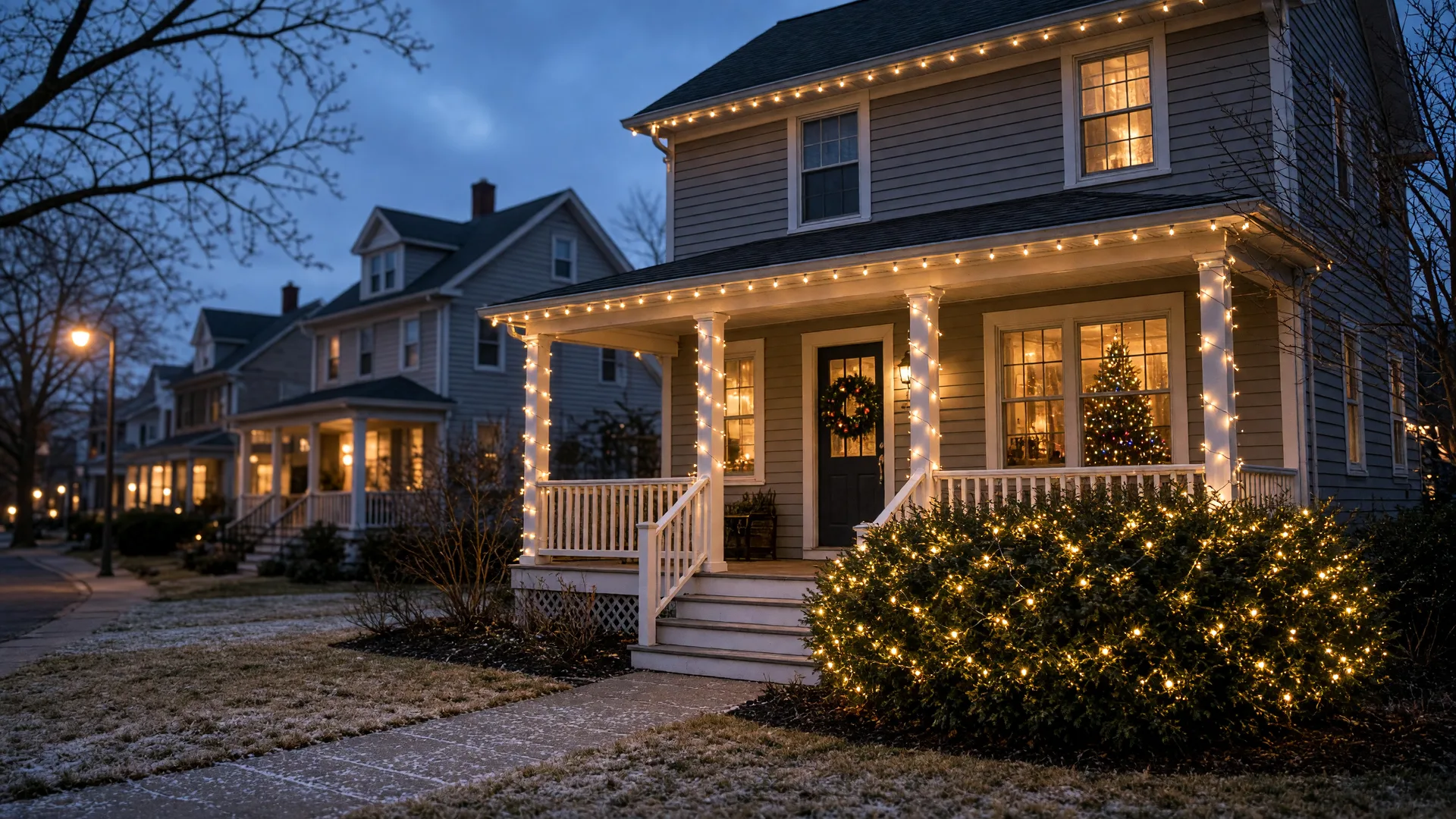
Early November is the time to pull the holiday light boxes out of the attic and check every strand before the first string goes up. In Delran the season kicks off with the Winter Festival and Tree Lighting on the first Friday of December, and the weeks of decorating before then are when most holiday electrical problems start. Nationally, electrical distribution or lighting equipment is involved in about 40 percent of home Christmas tree fires, and roughly 14,900 people were treated in emergency rooms for decorating-related injuries during the 2023 holiday season. This guide covers inspecting stored strands, string limits, outdoor-rated gear, real tree fire risks, and when to call an electrician, and pairs with the winter home maintenance guide for the rest of your cold-season prep.
Why Does Holiday Lighting Safety Matter So Much in Delran?
Holiday fires are rare, and they are almost entirely preventable, which is why the statistics are worth knowing. The National Fire Protection Association counted an average of 143 home structure fires per year started by Christmas trees between 2020 and 2024, with 7 deaths, 13 injuries, and $15 million in direct property damage, plus another 835 decoration fires a year. In about 40 percent of Christmas tree home fires, electrical distribution or lighting equipment was involved.
Delran is a town built for this kind of decorating. Two-story colonials and ranches across Tenby Chase, the side streets off Route 130, and the historic houses of Bridgeboro all get the roofline treatment in December, and much of the wiring in them dates to the 1950s through the 1970s. Add December rain, wind off the Rancocas, and freeze-thaw cycles, and a frayed strand becomes a real problem. The checklist below eliminates nearly all of that risk in one afternoon.
How Do You Inspect Lights That Have Been Stored All Year?
Attic heat and a year in a tangled box take a toll on light strings. Lay each unplugged strand out and run the wire through your hands looking for frayed or cracked insulation, bare wire, cracked or broken sockets, loose or missing bulbs, and sections that feel stiff or brittle. Check both plugs for bent prongs and scorch marks, then plug each set in briefly and swap out dead bulbs before hanging.
Do not save a damaged strand with electrical tape. Tape repairs are temporary, and a mended wire is exactly what fails in January. The Consumer Product Safety Commission says to throw out damaged sets, and Delran makes that easy: during December the Delran Green Team recycles old, broken, and no-longer-working holiday lights in the blue bin in the Municipal Building lobby at 900 Chester Avenue.
How Many Strands of Lights Can You Safely String Together?
The classic rule is the rule of three: never connect more than three strings of incandescent mini lights end to end. That is the limit the Consumer Product Safety Commission cites, because incandescent strings draw real wattage and a fourth set pushes the first one past what its wiring is rated for. The older mini-light sets in many Delran attics, plus C9 and C7 bulbs, follow this rule.
LED strings changed the math. They draw a fraction of the power, and many UL-listed LED sets can safely be chained in much larger numbers, but the number that matters is the one on each package label, because manufacturers set their own series limits. Follow the label, and use the warm-plug test as a second check. At the wall, use a power strip with a built-in breaker instead of stacking cube taps, spread the tree, window candles, and inflatables across different circuits, and never put a space heater on the same circuit as the lights.
Which Lights Belong Outside, and How Should You Hang Them?
Outdoor means outdoor-rated. A strand on the porch has to survive rain, frost, snow, and freeze-thaw swings, and indoor sets are not sealed for any of it. Buy lights and extension cords marked for outdoor use, and plug them into a GFCI-protected outdoor receptacle. If your porch or garage outlet is an older one, a GFCI plug adapter is a ten-dollar fix, and an electrician can swap the receptacle in minutes.
Hang lights with clips made for the job, never staples or nails. A staple driven through a wire pierces the insulation, and a damaged wire against a wood fascia is a shock and fire hazard waiting for a wet night. Keep connections off the ground, raise plugs above the mulch line, point them so water cannot run in, and route cords so they never cross a walkway.
Where Do Holiday Decoration Fires Actually Start Indoors?
Indoor holiday fires cluster around a few repeat patterns: overloaded outlets, cords run under rugs or pinched behind furniture, candles near decorations, and lighting left on all night. The NFPA data points straight at the wiring: electrical distribution or lighting equipment shows up in about 40 percent of home Christmas tree fires. Give strings room to breathe, keep cords out of door frames and away from under-rug heat traps, keep lit candles at least a foot from anything that can burn, and never put a candle on a tree.
December is also the month to make sure your alarms work, because it is one of the highest fire-activity stretches of the year. Test smoke detectors when you start decorating, replace old batteries, and confirm carbon monoxide detectors are live too, the heating system maintenance guide has the full checklist.
How Do You Keep a Real Christmas Tree from Becoming a Fire Risk?
A fresh-cut tree that gets water every day is a surprisingly safe decoration. Keep any real tree at least three feet from fireplaces, radiators, space heaters, and heat vents, and water it daily. The dryness test is simple: run your hand along a branch, and if needles fall in a shower rather than staying put, the tree is past its safe window.
The January number is the one most people miss. Roughly 35 percent of home Christmas tree fires happen in January, almost always because a tree that has been up for weeks has dried out and someone keeps it lit. Plan the take-down date now, usually the first weekend after New Year's, and if you want to stretch the season, LED lights run far cooler than incandescent on a real tree. A dry tree that drops its needles has to go.
What Is the Safe Way to Work on the Roofline and Second Story?
Falls, not fires, are the most common holiday decoration injury. The CPSC estimates about 160 decorating-related injuries a day during the season, nearly half from ladder falls. If you are hanging roofline lights on a two-story Delran colonial, the ladder rules are not optional: set the base one foot out from the house for every four feet of height, on level dry ground, keep three points of contact, and never overreach. Climb down and move the ladder.
Skip the ladder on wet or windy days, work in daylight, and have a spotter if you can. If the roofline is steep or the peak sits high, this is a job genuinely worth hiring out: the Delran contractor recommendations page lists established local crews, and a professional light-hanging company brings its own ladders, insurance, and clips rated for the work.
When Should You Call an Electrician Instead of Adding Another Extension Cord?
A breaker that trips the first time the whole display goes on is not a nuisance, it is your panel telling you the circuit is overloaded. That is the moment to stop plugging things in and call a licensed electrician. Watch for warm outlets or plugs, flickering lights, and receptacles that have never been updated.
Many Delran homes built in the 1950s through the 1970s, across Tenby Chase and the older sections off Route 130, still run on panels sized for a much lighter load. A dedicated 15- or 20-amp circuit for the display is a modest job for a licensed pro and ends the annual breaker game for good. The contractor page and the Homeowner Resources hub both have vetted local names to start with, and I am always happy to point you to the electrician I would call for my own house.
Frequently Asked Questions About Holiday Lights in Delran
How many strands of Christmas lights can I plug together?
For older incandescent mini lights, the rule is three sets maximum end to end, per the Consumer Product Safety Commission. LED strings draw far less power and can often be chained in larger numbers, but follow the limit on each package label. If a plug feels warm, you have too many in the chain.
Can I use indoor Christmas lights outside?
No. Indoor sets are not sealed against moisture and freezing, and a December rain followed by a hard freeze will crack sockets and short the wiring. Use only lights and extension cords marked for outdoor use, plugged into a GFCI-protected outdoor receptacle.
Is it safe to leave holiday lights on overnight?
It is better not to. Turn the display off when you go to bed or leave the house so a failing bulb cannot heat up while nobody is there. A timer or smart plug runs the lights from dusk until about 11 PM automatically and saves electricity too.
What should I check before hanging lights that were stored all year?
Lay each strand out and look for frayed or cracked insulation, bare wire, broken sockets, loose bulbs, bent or scorched plugs, and brittle wire. Replace damaged sets instead of taping them, and recycle old strands at the Delran Green Team bin in the Municipal Building, 900 Chester Avenue.
Should I use staples or clips to hang lights on my roofline?
Use clips designed for light strings, never staples or nails. A staple can pierce the wire insulation, and a damaged wire against a wood fascia is exactly the kind of short that starts a fire or delivers a shock. Light clips are cheap and made for the job.
What causes most holiday decoration fires?
Electrical problems top the list. The NFPA found electrical distribution or lighting equipment was involved in about 40 percent of home Christmas tree fires between 2020 and 2024, and about 35 percent of those fires happen in January when dry trees stay up too long. Keep real trees three feet from heat sources and water them daily.
Do I need a GFCI outlet for outdoor Christmas lights?
Yes. Modern electrical code requires outdoor receptacles to be GFCI-protected because they sit in the weather. If your porch outlet is not protected, use a GFCI plug adapter or have an electrician swap the receptacle. Never run outdoor lights from an indoor outlet through a window or door.
One afternoon of checks, the inspection, the string limits, the clips, the GFCI, the tree watering, prevents the two most common holiday problems: a popped breaker on the busiest night of the season, and a fire that starts in a worn wire or a drying tree. Pull the boxes down early, go through every strand before it goes up, keep outdoor gear outside and protected, and turn the display off when the house goes quiet. For the rest of the cold-season picture, the winter home maintenance guide picks up where the lights end, the energy efficiency guide covers the insulation and sealing work that keeps December bills down, and the holiday events guide has the full rundown on the 2026 Winter Festival and tree lighting. The seasonal activities guide keeps the whole month straight, and the Delran FAQ handles the quick holiday questions. Have questions about Delran? Contact Bob Millaway at 856.426.1522.
Have Questions About Delran?
Contact Bob Millaway at 856.426.1522. As an Epique Realty AI Certified Agent with over 728 homes sold and $115M+ in career sales, I have spent 20+ years helping Burlington County families get more out of their homes and neighborhoods, and I am always happy to share what I know.